
You’ve drawn up the plans, picked the kitchen units, maybe even priced the steel. Your House Extension Plan is Ready.
Then you start to worry: what happens if the neighbour complains? At least once a week, we get asked the question at Faulkner Surveyors Crawley – and while everybody wants to know, the honest answer is that most of the time, no, your neighbour cannot stop an extension which is in accordance with regulations.
Yet they can, and will, delay things, cost money all the while and in a small number of circumstances literally freeze the project in its tracks.
This guide tells you where the line really lies. We’ll talk about when neighbours have got a genuine legal right to be difficult, when they are just being awkward sods and what your build needs to do in relation to the Party Wall etc Act 1996.
The Short Answer
Your neighbour cannot stop you from creating an extension simply because they do not like it. While annoying, personal preference, the occasional disruption, or nature complaining has no legal ground. Only a genuine planning objection, via the Party Wall etc. Act 1996, trespass at the boundaries or interference with — for example, a right of way is enough to prevent an extension from going ahead.
Get the legal stuff out of the way and it is building time. And if you get it wrong, your neighbour has the prospect of a council enforcement notice and even a county court injunction.
When Can a Neighbour Really Stop Your House Extension Plans?
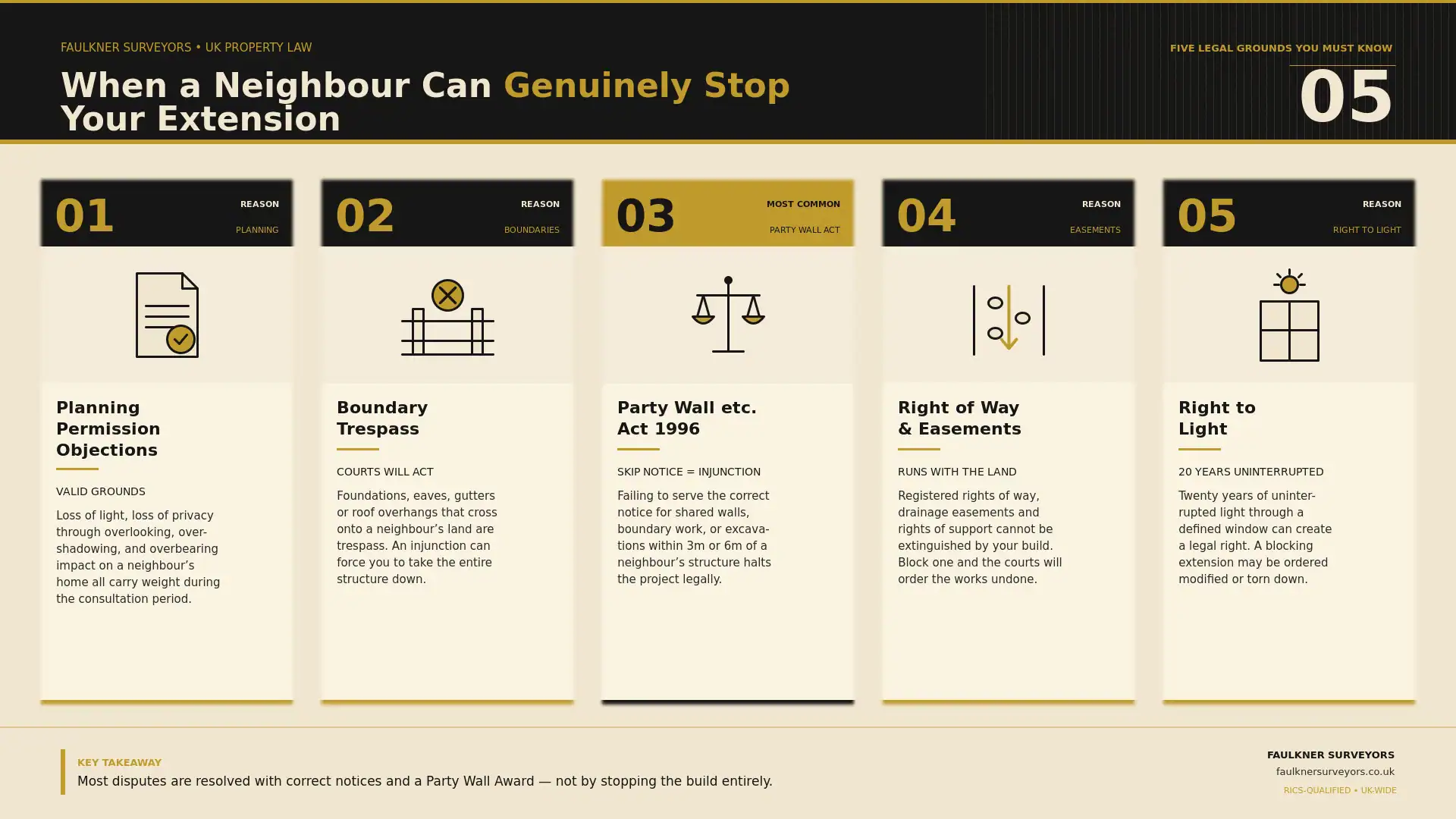
Five circumstances turn a complaint into a creature with teeth and nails.
1. Planning permission objections
If you intend to apply for a planning permission and if a neighbour objects on valid grounds during the consultation period, the local authority cannot just disregard that objection. Legitimate reasons might be loss of light, overlooking windows (loss of privacy), overshadowing, effect on the character of the area and overbearing impact (a structure that appears to dominate a neighbouring property). Know the Correct Sections Here
Just because some has objected, does not mean that the council have to refuse the application. The planning policy guides which objections carry weight for officers. According to the latest government figures, planning permission is usually granted even when neighbours object, unless the proposal goes against established policy.
2. Boundary trespass
Boundaries are rarely where people think they are. That fence you have stared at for a decade and a half may not be the boundary line. The title plans show only approximate boundaries. Make sure you clarify the boundary before you dive.
3. The Party Wall etc. Act 1996
If your extension involves work to a shared wall, building right up to the boundary, or excavating near a neighbour’s property, the Party Wall etc Act 1996 applies. Failing to serve the correct notice gives your neighbour the right to seek an injunction stopping the works until the procedure is followed properly.
This is the most common pitfall. We’ll come back to the details of the Act in a moment.
4. Right of way and easements
You cannot extinguish the right you would have owned by way of a wall put through it if one neighbour has taken a registered right of way across land on which you seek planning permission. Easements run with the land. The same is said about drainage easements and the rights of support. If you block one of these, chances are someone will order you to take that work back.
5. Right to light
Right to light can be attained after 20 years of continuous enjoyment of light through a defined aperture (normally a window). If your extension would dramatically block light to such a window, your neighbour may have a claim. They are technical cases, frequently implicating expert reports—but they take place in real life, and they stop extensions.
When a Neighbour Cannot Stop Your Extension ?

When Your Neighbour Cannot Stop your House Extension Crawley
- This list is longer than most homeowners realise. A neighbour cannot block your build because they:
- don’t like the design or materials
- worry about noise during construction (within reasonable hours)
- think the extension will reduce their property value
- object to the colour of the brick or render
- simply don’t want change
- disagree with you for personal reasons
None of these has legal standing on its own. If you want to object to a planning application, you need to write to the council quickly and explain your reasons, according to the Local Government Ombudsman.
Permitted Development: When Planning Isn’t Required
Many single-storey rear extensions fall under Permitted Development Rights, meaning no planning application is required. The headline rules for England, current at the time of writing:
- Terraced and semi-detached houses can extend up to 3 metres from the original rear wall under standard Rules.
- You can extend up to 4 meters if the house is a detached house under standard rules.
- Under the Larger Home Extension scheme, made permanent in 2019, those depths increase to 6 metres for terraces and semis, and 8 metres for detached houses.
- The maximum eaves height of 3 metres if this is situated within 2 metres of a boundary.
- Maximum height of 4 metres for the extension overall (single storey)
- The extension cannot cover more than half the area of land around the original house
The Larger Home Extension scheme requires the neighbour consultation procedure. Your neighbours get 21 days to object. If they do, the council has another 21 days to decide whether the size and impact are acceptable. The council’s decision here is about size impact, not about whether the neighbour personally approves of the build.
A property in a conservation area, an Article 4 area, or a listed property is subject to tighter restrictions. Always check before assuming PD applies.
The Party Wall etc. Act 1996, in Plain English Crawley

The Act gives you the legal right to carry out specific works that would otherwise count as trespass or nuisance, in exchange for following a notification procedure. It is not optional. If your works are notifiable and you skip the procedure, your neighbour can stop you.
Three types of notice exist:
| Notice | Trigger | Notice Period |
|---|---|---|
| Section 1 (Line of Junction) | New wall on or up to the boundary | 1 months |
| Section 2 (Party Structure) | Work to an existing party wall | 2 months |
| Section 6 (Adjacent Excavation) | Foundations within 3m or 6m of a neighbour’s structure | 1 Month |
- The 3-metre and 6-metre rules under Section 6 are worth understanding. You must serve notice if you are excavating:
- within 3 metres of a neighbour’s structure and below the level of their foundations
- within 6 metres of a neighbour’s structure and below a 45-degree line drawn down from the bottom of their foundations
Almost every rear extension involves Section 6 in some form, because new foundations sit close to the neighbour’s house.
Notifiable Works at a Glance
You’ll need a Party Wall Notice for, among other things:
- Cutting into a party wall to take a beam, common in loft conversions and through-lounges
- Inserting a damp-proof course into a party wall
- Raising or thickening a party wall
- Underpinning a party wall
- Demolishing and rebuilding a party wall
- Building a new wall along the boundary
- Excavations falling within the 3m or 6m rules
That isn’t the full list, but it covers the works behind nine out of ten extensions.
Know About the Party Wall Agreement Crawley, and How it is the best option.
Your Neighbour’s Response Options
Once you serve a notice, the neighbour has 14 days to respond. They have three choices:
- Consent in writing. The work proceeds. No surveyor needed.
- Dissent and appoint the same surveyor as you. A single surveyor, known as the Agreed Surveyor Crawley, prepares the Party Wall Award.
- Dissent and appoint their own surveyor. Two surveyors, working together, produce the Award.
If the neighbour does nothing for 14 days, dissent is deemed automatic, and you must appoint a surveyor on their behalf. The Final Award is a legally binding document Crawley that sets out how, when, and under what conditions the work will take place, as well as a record of the condition of the neighbouring property before work starts.
The cost of the Award normally falls on the building owner, that’s you, including the neighbour’s reasonable surveyor fees if they appoint separately.
How Long Does All This Take?
This is what realistic timelines look a bit like:
- Householder: ~8 weeks for a decision in simple cases (longer in more complex sites)
- Bigger house extension prior consent: As many as 42 working hours
- Party Wall: 2 months (with consent) + a few weeks
- Party Wall treatment with objection and an Award: 2 to 3 months from notice to signed Honour
To save time, these can all be rolled in parallel. If you suspect opposition, get the surveyor appointment process started early and serve party wall notices while the plans are being processed.
What if Your Neighbour Objects to the Extension Plans in Crawley, UK ?

A few important things that are real in nature:
- Talk first: Most are started by a neighbour reading about the extension in a council letter, not you. Skip the primary meeting, with plans in hand, to speak ideas over the fence; this will resolve many more problems than it creates.
- Do not be dreamy and agree on little: Occasionally, just a small tweak to the rear elevation — such as repositioning the abode rooflight or reducing the overlook from a window – will go for its objection, and very frequently these amendments amount to no more than the developments it seeks.
- Get the legal side right: Notices served correctly. Boundaries confirmed. Schedule of Condition prepared. However, when everything exists in written form, there is little room for a purely personal objection.
- Make sure you appoint an experienced surveyor to deal with Party Wall matters. Just like the neighbour, you are protected by the Award. In addition, if a Schedule of Condition is poorly drafted or not completed at all, you could be left vulnerable to expensive damage claims in the future, as such notices under Part 2 of the Act can also be invalid.
Where Faulkner Surveyors Crawley Come In
We are specialized and specifically work on the party wall Crawley and boundary is something we deal with almost daily. Most of our clients get to the stage where their extension drawings have already gone in with the council, and the builder is saying when can they get digging. We pick up and write the notices required, serve them, negotiate what the Award should contain with this neighbour’s surveyor [name}, and record the condition of their building so any claim for damage can be measured against a baseline. You can request a call back for a true assessment for your house extension plan Crawley.
If you have already received ire from a neighbour, then get in contact before things escalate. If notice is properly served and the Award is skilfully drafted, most disputes become a procedural exercise rather than a battle.
Frequently Asked Questions and How You Can Respond to the Objections of your Neighbour
Q. Can my neighbour stop my extension Crawley if it has planning permission?
Not on planning grounds, no. Once planning permission is granted, that route is closed. They can still object on Party Wall, boundary, or easement grounds if those issues exist.
Q. What happens if I don’t serve a Party Wall Notice Crawley?
Your neighbour can apply to the court for an injunction to halt the works. You’ll then have to serve notice retrospectively, deal with the dispute, and probably pay both sides’ surveyor fees. The delay alone often costs more than doing it correctly from the start.
Q. Does the Party Wall Act apply to detached houses?
Yes, often, because of the 3-metre and 6-metre excavation rules. Even if there’s no shared wall, foundations dug close to the neighbour’s house bring you under Section 6.
Q. Can I build right on the boundary?
According to Some Case Reports, if you want to build a wall on your land up to the boundary under Section 1 of the Party Wall Act, you must serve your neighbour with a Line of Junction notice and wait at least one month before starting work unless they give permission for an earlier start.
There is automatic dissent after 14 days of silence. You designate a surveyor on their behalf, and the process continues. The work doesn’t go away because they refuse to engage; only the appointment of the surveyor changes.
Q. What is the cost of a Party Wall Award?
The building owner normally pays. That also means costs vary with complexity; often, a one-property, single-surveyor Award sits in the low four-figures. The number increases with more neighbours, whether surveyors are appointed independently or trenches are dug.
Considering an extension and concerned about the neighbours? Speak to Faulkner Surveyors. We will identify which notices are relevant, handle the process, and keep the project moving forward,, allowing you to focus on the physical build.