
Soundproof Party Wall in Crawley: What You Need to Know
Noise can be particularly frustrating when you live in a shared property. Can I Soundproof A Party Wall? Yes, you can soundproof a party wall, but first learn your options and how the law affects each choice. In this article, we will provide a comprehensive guide to help you make the right choice.
Get the Help of a professional party wall surveyor Crawley.
What is a Party Wall? Is Soundproof Party Wall Allowed Crawley?
A party wall is a wall that separates two adjoining properties. It can be a structural wall or a non-structural wall, and it’s usually shared between the two properties. Party walls are found in semi-detached and terraced houses, flats, and commercial properties.
Legal Implications
When soundproofing a party wall, first check who owns what. If that wall is entirely on your property, go ahead and soundproof it! But, if the wall is a common boundary wall, then both neighbour equally owns that, and any work done should be with the consensus of both.
Check whether there is a party wall agreement in Crawley, is in place if the wall is a boundary wall that adjoins someone else. A party wall agreement with your neighbours is a legal contract that governs shared walls between neighbouring property owners and defines the parties’ rights and obligations. Any party wall modelling work must be carried out in accordance with the agreement.
Options for Soundproof Party Wall Crawley
- Acoustic Insulation – One of the most effective ways to soundproof a party wall is to install acoustic insulation. This involves adding a layer of sound-absorbing material to the wall, reducing the amount of noise that passes through.
- Mass-Loaded Vinyl – Mass-loaded vinyl is a dense, flexible material that can be added to a party wall to reduce noise transmission. It’s effective at blocking out noise and is often used in commercial and residential buildings.
- Resilient Channels – Resilient channels are metal strips that are installed on the wall before adding a layer of drywall. They help to absorb and disperse sound waves, reducing noise transmission.
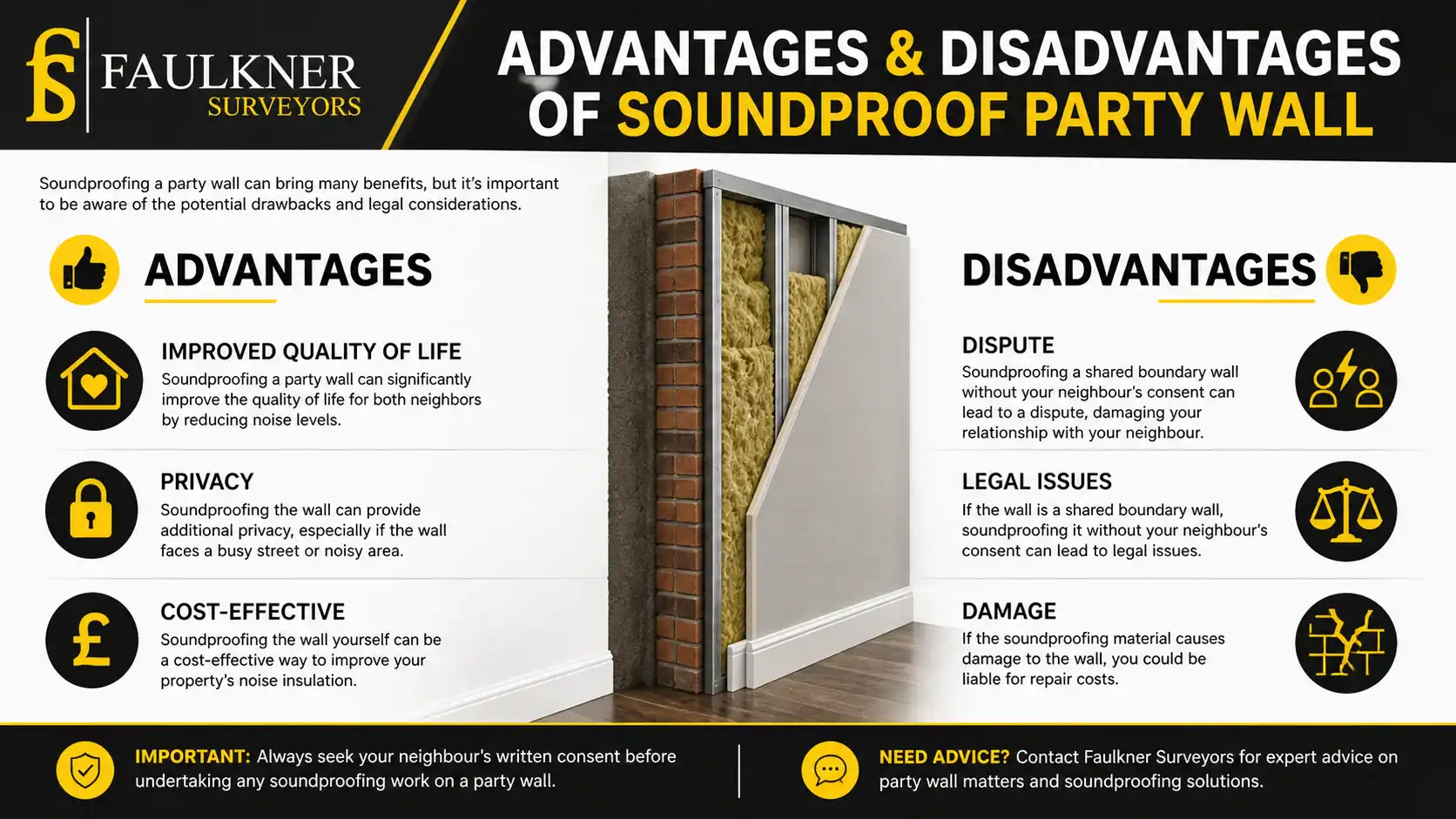
Advantages and Disadvantages of Soundproof Party Wall Crawley
Advantages:
- Improved quality of life: Soundproofing a party wall can significantly improve the quality of life for both neighbours by reducing noise levels.
- Privacy: Soundproofing the wall can provide additional privacy, especially if it faces a busy street or noisy area.
- Cost-effective: Soundproofing the wall yourself can be a cost-effective way to improve your property’s noise insulation.
Disadvantages:
- Dispute – Soundproofing a shared boundary wall without your neighbour’s consent can lead to a dispute and damage your relationship with your neighbour.
- Legal issues – If the wall is a shared boundary wall, soundproofing it without your neighbour’s consent can lead to legal issues.
- Damage – If the soundproofing material causes damage to the wall, you could be liable for repair costs.
Conclusion
To sum up, a party wall that serves as a sound barrier can really make life easier for both neighbours by reducing noise. But first, you need to know about the legal implications and your rights. Where the wall is on the boundary between properties, work on a boundary wall must be completed with the agreement of both parties (possibly under a party wall agreement). Faulkner Surveyors supplies boundary services.
Know whether an Architect can act as a Party Wall Surveyor in Crawley, UK
FAQs: Can you soundproof a Party wall Crawley?
Am I legally allowed to soundproof the shared wall in my terraced house?
You must establish exact ownership first. According to GOV In the UK, if the wall is built entirely on your own land and is not used by neighbouring properties to separate their buildings, you have full control over it. However, if a wall on your property is also used by others to separate their buildings, it is considered a party wall. However, most terraced houses share a boundary wall. According to the UK government, if you want to make changes, such as adding soundproofing materials to a party wall, you need to inform your neighbour and obtain their agreement before starting the work.
What happens if I install acoustic panels without asking my neighbour?
If you skip the permission step, it invites massive legal headaches. You ruin neighbourly negotiations by modifying a boundary without permission. If the original masonry is damaged during your installation, you are responsible for all costs of replacement. By the way, ignoring an existing Party Wall Agreement, which has stringent terms, exposes you to extreme, immediate legal risk.
Which specific materials block noise most effectively on these dividing structures?
These three tested-and-true tactics are the ones that builders typically rely on. Many acoustic insulation materials sandwich a thick, sound-absorbing layer directly onto the brick face. Mass rask load vinyl is a high-density, flexible barrier commonly used in many modern commercial spaces. If you are looking to offer an option. Some homeowners prefer resilient channels. These thin metal strips are mounted behind the drywall, and as sound waves travel toward your living room, they spread them out and break them up before they ever arrive.
Will upgrading my wall insulation actually save me money?
It certainly can. Labour is always expensive, especially when hiring professional construction crews. Of course, many handy homeowners handle simple soundproofing over a weekend with some good old-fashioned elbow grease. Considering you do the heavy lifting, it makes this an oddly affordable addition. Aside from the direct cost benefit, reducing road noise pollution improves your daily life and offers significant health benefits.
What exactly does a formal party wall agreement do for my project?
This critical document acts as a binding legal contract between adjoining property owners. It clearly outlines exactly what you can and cannot do to the shared physical structure. Whenever you plan construction work, such as installing heavy resilient channels, you must follow the agreed terms exactly. It protects both homes from accidental damage and stops bitter boundary disputes before they even start.